



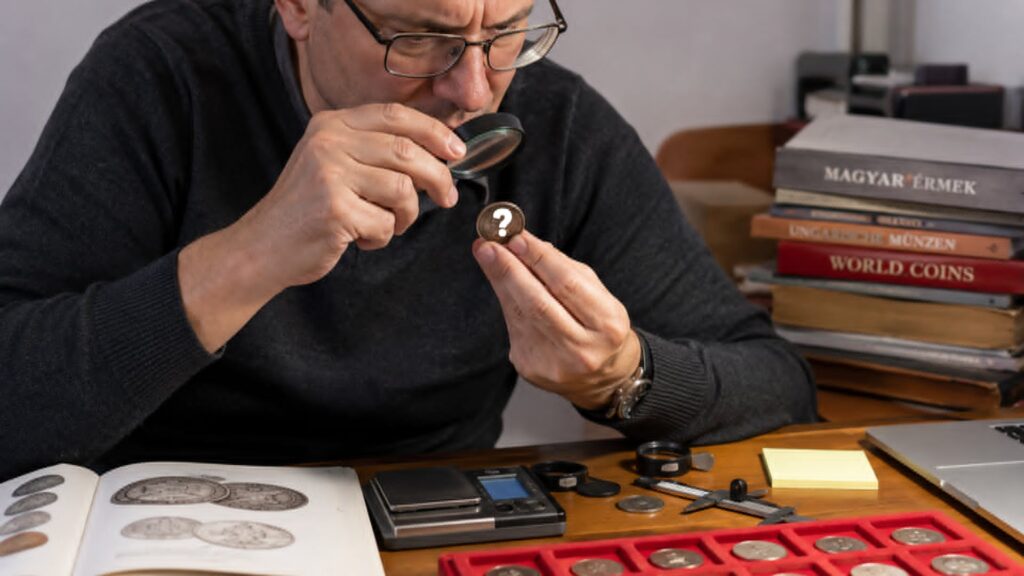
How do we examine a coin?
A 10-point checklist for the novice collector
You spot a lovely coin. You like it. They say it’s rare. According to the seller, it’s, of course, „guaranteed to be genuine”, „never cleaned”, and was more or less dug out of grandad’s drawer the day before yesterday.
In situations like this, you shouldn’t buy it straight away. You should have a look at it first.
One of the most important aspects of coin collecting is not the purchase itself, but what happens beforehand. An experienced numismatist can often spot that something is amiss within a matter of seconds. A beginner needs more time for this – and that is perfectly natural.
Let’s take a look at the ten things you should check before you get your wallet out.
1. Weight – the coin doesn’t lie. Usually.
A digital scale with adequate accuracy is one of the cheapest and most useful numismatic tools.
If, according to a catalogue, the coin weighs around 3.50 grams, but our specimen weighs 2.83 grams, then we shouldn’t start by saying: „That’s surely how it was back then.”
It may be due to wear and tear, or weight fluctuations from that period; the piece may be truncated or damaged – or it may be a forgery.
The key point is this: first, we need to establish what degree of variation is considered normal for a given type of coin. We do not examine a medieval, hand-struck gold coin with the same degree of tolerance as a modern machine-struck coin.
2. Diameter – get the calliper out!
The next simple piece of information is the diameter. Of course, there’s no need to call in the numismatic police over a difference of one or two tenths of a millimetre. Such variations are particularly common in old coins struck on irregular blanks.
But if the catalogue states 21 mm and we have a 24 mm piece in front of us, it’s worth asking a few questions. Weight and diameter together tell us much more than they do separately.
3. Material – is it really gold that glitters?
This old saying is particularly useful in numismatics. Gold, silver, copper and their alloys each have their own characteristic colour, surface and behaviour. An experienced eye can already recognise many things, but it is worth supplementing our visual assessment with instrumental analysis.
For higher values, XRF analysis, for example, may be considered, as it provides information on the elemental composition of the surface without causing any damage.
But be careful here too: a good composition does not in itself prove that the coin is genuine. A counterfeit coin can also be made from gold of the appropriate fineness.
4. The edge – a place many people forget to look at
A coin is not a two-dimensional object. It also has a third side: its edge.
And sometimes that is precisely where the forgery is given away. Casting seams, filing marks, polishing marks, traces of subsequent machining, soldering marks or other unusual features are often visible when viewed from the side.
That is why we should always turn a coin over and over. Anyone who only looks at the front and back is like someone buying a second-hand car without bothering to open the bonnet.
5. Captions and letters – the devil really is in the detail
One of the most tell-tale signs of a forgery is often the lettering. Let’s take a closer look at the shape and thickness of the letters, their positioning in relation to one another, the strokes, the dots and separators, and how the letters meet the margin.
The appearance of the lettering on a struck coin may differ from that on a cast coin or a replica produced using modern methods. This is where a magnifying glass and experience really come into their own.
6. Green marks, master marks and small marks
A small dot. A star. A letter. A coat of arms.
As a beginner, it’s easy to overlook them, even though they are sometimes what determines whether you’re holding a 100-euro or a 10,000-euro version.
Based on the mint marks and master marks, it is possible to determine the mint, the period, the master of the mint and, in some cases, even a very rare variant.
That is why we say time and again: without a catalogue, it is difficult to take numismatics seriously. Memory is useful. Specialist literature is better.
7. Surface – this is where the real investigation begins
A whole new world opens up under a magnifying glass. Look for hairline scratches, traces of polishing, parallel lines resulting from cleaning, unusual porosity, casting marks, corrosion, repairs, soldering or artificial patina.
One of the most common mistakes made by beginners: „It’s very shiny, so it must be very beautiful.”
Not necessarily. It might be sparkling clean. But it could also be that someone had gone to town on it half an hour earlier with some miracle product, because they thought they had to get rid of two thousand years’ worth of grime in five minutes.
In numismatics, a surface that is too pristine is sometimes just as suspicious as one that is unsightly.
8. Wear and tear or a weak beat?
That’s a trickier question. If a detail is missing from a coin, there could be several reasons for this. It may have worn away. Or it may never have been properly struck in the first place.
Weak striking, misaligned dies, blanks defects and uneven pressure are particularly common in old, hand-struck coins.
This is important because the two are not the same. A coin that has been poorly struck but has seen very little circulation may be assessed quite differently from a genuinely worn specimen.
9. Let’s compare it with other copies!
This is one of our strongest assets. Let’s look for auction archives, museum specimens, images from specialist literature, NGC/PCGS-certified specimens and previous auction appearances.
Let’s not just look at how it „resembles” the original. Let’s look for the differences. Where is the letter positioned? Where does it touch the coat of arms? What does the crown look like? Where does the legend end? Is there a mint mark in the same place?
With more complex pieces, we can even look for exact matches.
And this is when, at eight o’clock in the evening, you find yourself saying, „I’ll just have a look at this one more copy…” And then, at half past one in the morning, you’re leafing through a Swiss auction catalogue from 1973.
Welcome to numismatics.
10. If you don’t like something – don’t try to explain it to yourself!
This is perhaps the most important point.
If three or four things seem odd when examining a coin, let’s not start coming up with separate explanations for each one.
„The weight must be down to wear and tear…”
„The rim must have been damaged a long time ago…”
„They must have just taken a bad photo of the surface…”
„And perhaps that’s why the letters look like this…”
It’s possible.
But when we have to come up with five separate stories just to maintain a play’s originality, it’s time to put it back on the table.
It’s a shame to miss out on buying a good coin. Buying a bad one is far worse.
A quick 10-point check on Procopius
- Weight – Does it match the model?
- Diameter – Is that correct?
- Material – Is it as it should be?
- Perem – Can we see any tampering, stitching or filing?
- Letters and details – Are they natural, with a textured appearance?
- Green and master tickets – Do they match the model?
- Surface – Is it original, or has it been cleaned, polished or repaired?
- Wear and tear – Genuine wear and tear or just a bit of a knock?
- Comparison – Can we find an authentic reference copy?
- Overview – Does it all make sense, or do we need to explain too much?
And one more thing…
We rarely declare a coin to be a forgery on the basis of a single feature.
A coin that is too light is not necessarily counterfeit. A strange edge is not necessarily counterfeit. An unusual surface is not necessarily counterfeit either.
The essence of numismatic analysis lies precisely in evaluating the features as a whole.
And for that, three things are needed: knowledge, comparison and experience.
The first two can be obtained relatively quickly. The third, however, requires you to get your hands on thousands of coins.
And perhaps that is one of the most wonderful things about coin collecting: the more we know, the more we notice – and the more we realise just how much we still don’t know. (Me neither.)
.
Professional background
Background materials used for the professional review of this article: NGC – Learn Grading: The Parts of a Coin; NGC Ancients – Strike, Surface and Style; American Numismatic Association – Official Grading Standards and Basics Every Coin Collector Should Know.