

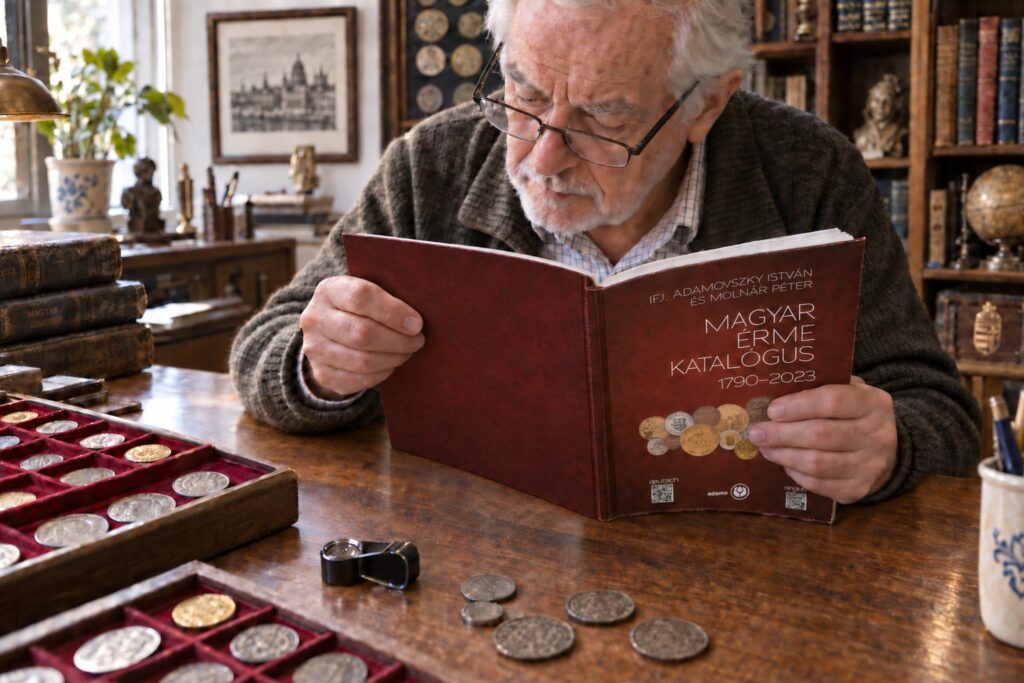
Is it rare, or does it just look old? What makes a coin rare?
„It’s very old, so it must be valuable” – this is one of the most common misconceptions encountered in numismatics. Yet the age of a coin, in itself, says nothing about its rarity or market value. There are coins dating back two thousand years of which large quantities still exist today, whilst a coin barely a hundred years old, of a particular year or variant, can be a genuine rarity.
But what makes a coin rare? Is a low mintage sufficient? What do the designations R, RR and RRR in catalogues mean? And how can a collector determine whether they are actually holding a truly special specimen?
Just because something is old doesn’t necessarily mean it’s rare
In antiquity, the Middle Ages and the modern era, vast quantities of coins were minted. Coins were constantly needed to facilitate day-to-day trade, which is why as many as several million of certain types may have been produced.
If a large number of copies of such a coin have survived, it regularly turns up at auctions, and collector demand is not particularly strong, then the coin does not necessarily represent great value, despite its significant historical age.
The opposite is also true. A relatively recent coin may be rare if only a small number were minted, if the majority of the issue was subsequently withdrawn from circulation or melted down, or if only a few examples remain in good condition.
Age, therefore, is not in itself a measure of rarity.
The run count is just the beginning of the story
When assessing the rarity of a coin, many people look first at the mintage figure. This is indeed an important piece of information, but on its own it can easily be misleading.
It does, in fact, matter how many of the coins originally minted have survived to the present day. Even a coin with a large mintage could have become rare if a significant proportion of the specimens:
- they were coated and melted down;
- were destroyed during wars or financial crises;
- they used it to mint new coins;
- were lost or buried;
- It was completely worn out due to heavy use.
In other cases, almost the entire mintage of a commemorative coin with a low mintage figure may have survived because the owners set them aside from the outset. Such coins may appear rare on paper, but they are regularly available on the market.
The crucial question, therefore, is not merely how many were produced, but also that how many copies might exist today, and how often they appear on the market.
There are various kinds of rarities
When we describe a coin as rare, it is worth clarifying in what sense it is rare.
Rarity of type: Only a few examples of each variant of this particular type of coin are known to exist.
A rare vintage: The model itself is common, but individual model years are rarely found.
Rarity of green marks: The same coin was struck at several mints, but the coins from one of them are considerably rarer.
Variant rarity: There are differences in the inscription, the coin’s design, the coat of arms, the portrait of the monarch or other small details. These differences are sometimes clearly visible to the naked eye, whilst at other times they can only be detected upon close examination.
Rarity of breeding: The coin is commonly found in worn condition, but examples of excellent quality are rarely seen. This is particularly important in the case of coins that have been in circulation for a long time.
A coin may therefore be common in general, whilst a particular year of issue, mint mark or exceptional state of preservation may be considered a genuine rarity.
The degree of conservation can affect rarity
In previous instalments of the Procopius Coin School, we have already discussed the importance of quality and condition. These factors are also decisive when assessing a coin’s rarity.
It may be the case that several thousand examples of a particular type have survived, but almost all of them are heavily worn, damaged or have been cleaned. If a specimen of this coin with its original surface and a mint-like lustre were to turn up, it could represent an entirely different category for collectors.
It is therefore important to distinguish between the following:
- a rare type of coin;
- a rare vintage or variant;
- a rare quality.
In the grading systems used by American grading companies, the designation „Top Pop” is often encountered. This means that, amongst the coins graded by that particular grading company, the coin in question has received the highest grade. However, this does not necessarily mean that there is no coin in the world that is more beautiful or of the same quality. It applies only to coins listed in that company’s records.
What do the abbreviations R, RR and RRR mean?
Numismatic catalogues often use letters to indicate the degree of rarity:
- R – rare;
- RR – very rare;
- RRR – extremely rare.
Some publications use a more detailed system than this, whilst others specify a particular, known number of copies. It is important to note, however, that these classifications are not entirely consistent. An RRR rating does not mean the same thing in every catalogue, and data from older specialist literature may become outdated over time.
New specimens may come to light from collections, estates, archaeological finds or previously unprocessed material. It may also happen that a coin believed to be rare at the time a catalogue was compiled subsequently appears regularly on the market.
The ‘rare’ designation should therefore always be treated as a guide rather than as indisputable evidence.
It’s rare, but is there a demand for it?
Rarity and value are not the same thing. A coin may be extremely rare, but if few collectors are interested in that particular subject area, its price may remain modest. On the other hand, there may be fierce competition at auction for a coin that is less rare but extremely popular.
This value is determined by a combination of several factors:
- rarity;
- maintenance level;
- historical significance;
- aesthetic appearance;
- authenticity and an unspoilt surface;
- origin, or provenance;
- current demand from collectors.
One of the most important rules of the numismatic market is that It is not the rarity assumed by the seller, but the actual demand from knowledgeable collectors that determines the price.
How do we check the rarity of a coin?
It is not worth drawing conclusions based on a single online search result or seller’s advert. For a reliable assessment, you need to compare several sources.
Worth a look:
- What do the specialist catalogues for that field say?
- How often has the coin featured in auctions in recent years?
- Are we talking about the same model year, colour and variant?
- In what husbandry conditions were other specimens found?
- Are we actually seeing a sale price, or just an asking price with no completed sale?
It is particularly risky to rely solely on online advertisements. Whilst anyone can advertise a coin at any price, this does not prove that there will actually be a buyer at that price. The results of completed auctions are generally much more useful for assessing the true market value.
A small difference can sometimes make a big difference
There may be a significant difference in value between two coins that appear completely identical at first glance. This difference may be due to a tiny mint mark, a different typeface, an incorrect year date, a different coat of arms design or a modified die.
It is therefore not enough simply to identify the ruler, the face value and the year. To determine the coin’s exact characteristics, both sides, the inscription, the mint mark, the edge, the weight and the size must also be examined.
True rarities are often not particularly striking. Sometimes it is just a detail measuring a few millimetres that distinguishes a common variant from a major numismatic rarity.
Summary
A coin is not rare simply because it is old, unusual or because a quick internet search yields few results. To determine a coin’s rarity, one must be familiar with the issue details, the number of surviving examples, the various variants, its prevalence according to condition, and the frequency with which it appears on the market.
The most important rule:
The mintage figure is a fact. Rarity, on the other hand, is a finding of research.
If the rarity of a coin cannot be clearly determined, it is worth consulting a specialist catalogue or an experienced numismatist. A detail that seems insignificant can sometimes conceal considerable value – but only if we know exactly what to look for.