




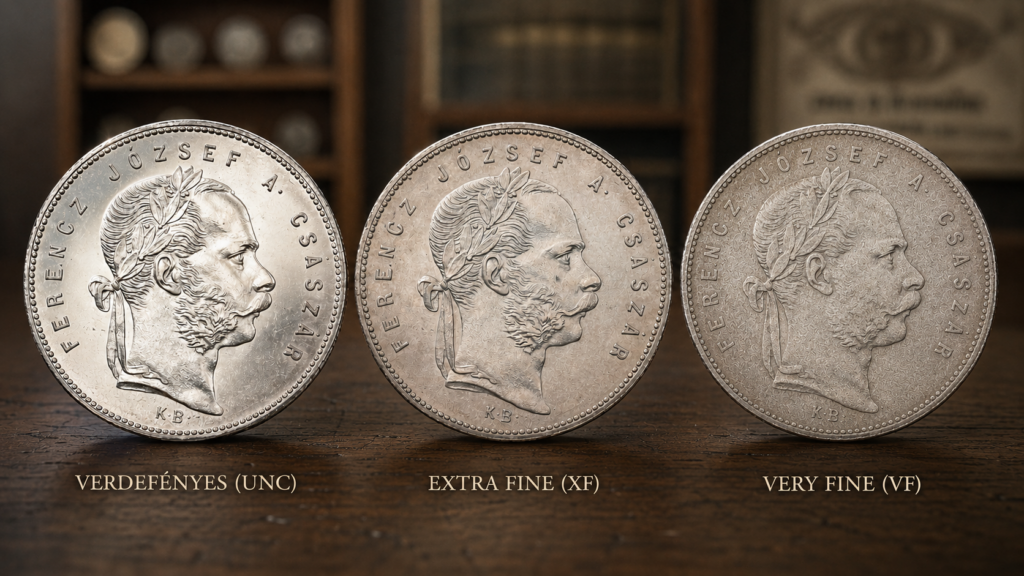
The importance of quality
Maintenance payments in Europe and the USA
There can be a price difference – sometimes even a multiple or an order of magnitude – between two coins of the same type, from the same year and with the same mint mark. This difference is often due not to rarity, but to condition. Anyone who learns to recognise genuine quality will not only build a finer collection, but will also avoid a significant proportion of the most costly beginner’s mistakes.
One of the most important pieces of advice in the previous section was that quality is generally more important than quantity. At first glance, this seems like a simple rule; in practice, however, condition grading is one of the most complex areas of numismatics. It is not enough simply to determine whether a coin is worn. One must pay attention to the quality of the strike, surface damage, the ‘verde’ lustre, the patina, the centring, signs of cleaning, and also to the original quality in which that particular type of coin was struck.
In this section, we outline the text difficulty levels commonly used in Europe, the American 1–70-point system, and explain why it is not possible to simply map the two scales to one another using a single conversion table.
1. Why is this condition so important?
The collector’s value of a coin is determined by a combination of factors: rarity, demand, historical significance, authenticity, metal, provenance and condition. Condition is particularly important because, within the same type, it is what distinguishes ordinary, fine and outstanding specimens from one another.
What’s more, the price difference is not linear. A very fine coin is not necessarily just 20 per cent more valuable than a fine specimen. In certain series, the price of the few best-known specimens can be several times that of specimens in average condition. This is what we call ‘condition rarity’: the type itself may be common, but in excellent condition it is extremely rare.
PROCOPIUS'S TIP
Always compare coins of the same type, year of issue and mint mark. The rarity of a coin from a different year or mint may be completely different; therefore, a difference in price does not in itself imply a difference in condition.
2. Quality is more than just wear and tear
A novice collector often looks only at how much detail remains on the coin. Whilst this is certainly fundamental, quality depends on more factors than that. The experienced eye examines at least five distinct areas.
- Wear: The highest points on coins in circulation are the first to start wearing down. On portraits, this may be the hair, the moustache, the face or part of the crown; on coats of arms, it may be the crown, the shield or the raised details of the animal figure.
- Green light: On the surface of a freshly minted coin, the flow of the metal can create a distinctive, circular play of light. The presence of natural verdigris is an important indicator, but it is not the same as a glint: a polished or chemically cleaned coin may glint, yet it does not have a verdigris sheen.
- Surface marks: Dents, scratches, hairline scratches, edge defects and storage marks can detract from the overall appearance even if the coin has never been in circulation. This is why a coin may be free from wear and yet still only be graded MS60 or MS61.
- Beating quality: A weak strike, a worn die, a faulty flan or poor centring do not constitute wear and tear from circulation. It is particularly important, in the case of hand-struck coins from the Middle Ages and the early modern period, to distinguish between original minting defects and subsequent damage.
- A feast for the eyes: The interplay of patina, colour, lustre, centring and surface finish all influence how attractive a coin is. For this reason, there can be a significant difference in market value between two coins with the same numerical grade.
COMMON ERROR
A shiny coin is not necessarily proof-like. Cleaning may remove the original surface finish, leave parallel hairline scratches, and permanently reduce its collector’s value.
3. The European system: a situation put into words
In Europe, text-based, so-called descriptive grades are traditionally used. In Hungarian auction descriptions, we often come across the terms ‘poor’, ‘fair’, ‘good’, ‘very good’, ‘excellent’ and ‘brilliant’. In international catalogues, the English, German, French or Italian equivalents of these may appear.
The main difficulty is that there is no single European standard that is exactly the same in every country and at every auction house. ‘Very fine’, the German ‘sehr schön’, the French ‘très beau’ and the English ‘Very Fine’ may denote a similar range, but their specific usage can vary. Some dealers apply stricter grading criteria, whilst others are more lenient, and the specific characteristics of a particular coin type also influence the interpretation.
Weak / Poor / Fair: The coin is heavily worn, but the type is still identifiable. It is collectable in the case of rare specimens, but is generally not in high demand for common types.
Good or average / Good / Very Good: The main motifs and most of the inscription are recognisable, but the finer details have largely worn away.
Szép / Fine: There is even wear from circulation, but the main details are clearly visible. The inscription and the date are generally legible.
Very Fine: Moderate wear; many fine details remain. The high points are worn, but the overall appearance of the coin is distinct.
Excellent / Extremely Fine: Only slight wear is visible on the highest points. Most of the detail has been preserved, and in some places traces of the green pigment are still visible.
Near-mint / About Uncirculated: There is very slight wear, mostly visible only at the highest points. A significant proportion of the green colour may remain.
Shiny / Uncirculated / Mint State: There is no wear and tear from normal use. However, it may still show signs of knocks, bag marks or storage marks, minor dents and other surface imperfections.
THROUGH THE EYES OF AN EXPERT
The degree of finish must always be assessed in relation to the specific type of coin. The surfaces of a hand-struck Árpád-era denarius, a Transylvanian thaler and a modern proof commemorative coin cannot be mechanically compared using the same set of criteria.
4. The American 1–70-point scale
In the United States, the Sheldon scale became the standard. William H. Sheldon originally developed the system, ranging from 1 to 70, in 1948 to evaluate early American cents. The numerical scale was later extended to other coins, and from the 1980s onwards, independent grading companies – foremost among them PCGS and NGC – brought it to international prominence.
The scale does not use seventy equally spaced grades. Several numbers are omitted below sixty. Coins that have been in circulation are graded between 1 and 58, whilst normal strikes without circulation wear are graded in the MS60–MS70 range. MS is short for Mint State. For proof coins, the prefix PR or PF may appear, depending on the supplier; this indicates the method of striking, not that the coin is automatically flawless.
- PO1-FR2: a piece that is extremely badly worn but still identifiable.
- AG3-G6: heavily worn; the outlines of the main motifs and the basic details are still recognisable.
- VG8–VG10: significant wear, but the main features are now more distinct.
- F12–F15: moderate, even wear; the main details are clear.
- VF20–VF35: moderate wear; many fine details are still visible.
- XF40–XF45: slight wear on the high points; most of the original details are still present.
- AU50–AU58: very slight wear; AU58 often appears almost mirror-like.
- MS60–MS70: no signs of wear from circulation; the grades are distinguished by marks, lustre, hammer marks and the overall appearance.
In the range above 60, the degree of wear is no longer the decisive factor, as, in theory, none of these coins have ever been in circulation. An MS60 may be heavily pressed, poorly struck or less attractive, whilst an MS65 is already strikingly fine and an MS67 is exceptional. The 70 grade denotes flawless, top-quality condition; according to NGC’s definition, such a coin must show no manufacturing defects even under five times magnification.
AN IMPORTANT DIFFERENCE
The distinction between AU58 and MS60 is not simply a matter of appearance. An AU58 coin may be more visually appealing than an MS60 coin covered in marks, but the former has minimal circulation wear, whilst the latter has none.
5. Europe and the USA: only an approximate correspondence
The following table is for guidance only and does not constitute an official conversion rate. The use of European terminology may vary by country, auction house and coin type. For a definitive assessment, the coin itself must always be examined, preferably via a high-resolution photograph or in person.
| International description | Common Hungarian term | American province | General overview |
| Poor / Fair | heavily worn | PO1-FR2 | Identifiable, few details |
| Good | poor to moderate | AG3-G6 | General outline, severe wear and tear |
| Very Good | average to good | VG8–VG10 | The main elements are distinct |
| Fine | beautiful | F12–F15 | Even wear, legible details |
| Very Fine | very beautiful | VF20–VF35 | Moderate wear and tear, lots of detail |
| Extremely Fine | excellent | XF40–XF45 | Slight wear on the high points |
| About Uncirculated | almost greenish-grey | AU50–AU58 | Minimal wear and tear, plenty of original shine |
| Uncirculated / Mint Condition | greenish-shiny | MS60–MS70 | No wear and tear from use |
Note: The table is for guidance only. The use of FDC, Stempelglanz, BU and other trade designations varies considerably, so these should not be automatically converted to a single American grade.
6. What does ‘green light’ actually mean?
In Hungarian, the term ‘verdefényes’ can refer both to the absence of circulation wear and to the presence of the original verdigris patina. However, the two are not always one and the same. A coin may not have been in circulation, yet still be dull, stained or bearing many marks of storage. On other occasions, a slightly worn AU58 specimen that retains much of its original lustre may be more striking.
The ‘verde’ sheen is caused by the reflection of light off the microscopic metal flow lines formed during striking. When the coin is tilted, a so-called ‘cartwheel’ effect – often appearing as a circular pattern – can be observed. Cleaning can damage or remove this delicate structure. Therefore, the condition of the coin cannot be reliably assessed from a single photograph taken from the front.
7. Cleaning, damage and the ‘Details’ rating
American grading companies do not assign a numerical grade to every original coin. If the surface is affected by heavy cleaning, scratching, corrosion, pitting, repairs or other significant issues, the coin may receive a so-called ‘Details’ grade. In such cases, the label indicates the approximate level of wear and the nature of the problem, but the coin is not included in the standard grading scale of 1–70.
In Europe, it is common for an auction house to specify a condition grade and then describe the fault separately: for example, ‘very fine, cleaned’ or ‘excellent, edge flaw’. This is not a contradiction. The condition grade indicates the level of wear and the degree of detail remaining, whilst the comment specifies the surface issue. From a market perspective, however, the flaw must not be overlooked: a cleaned or repaired piece is usually significantly less sought-after than its counterpart with the same level of wear but an original surface.
COMMON ERROR
Never try to ‘improve the appearance’ of a coin at home. Rubbing, polishing, or treating it with acids or strong chemicals can cause irreversible damage in a matter of minutes.
8. Why are the case and the number not infallible?
An important advantage of independent grading is that it verifies authenticity, provides the market with a more consistent terminology, and reduces the information asymmetry between buyer and seller. However, the number appearing on the case and the label does not replace the coin itself. The grading is a professional opinion, not a natural constant. In borderline cases, the same coin may receive a different grade when assessed at a different time or by a different group of experts.
Even within the same grade, there are weaker and stronger specimens. Colour, patina, spots, centring and the sharpness of the strike can all result in significant differences. The ‘Top Pop’ or ‘finest known’ designation can command a substantial market premium, but one should always check how many specimens of that particular type have been graded, and whether they are indeed from the same variant, mint mark or year of issue.
PROCOPIUS'S TIP
Look at the coin first, then the label. Ask yourself: would I buy this very same coin even without the case and without knowing the number on it?
9. Special cases: hand-struck and historic coins
When valuing medieval Hungarian gold forints, denars, Transylvanian thalers and other hand-struck coins, the logic developed for modern machine-struck coins can only be applied with caution. It is common for these coins to have uneven surfaces, missing edges, double striking, poor centring, a partially missing circular inscription or wear on the die. Such features may be entirely contemporary and result from the striking process itself; therefore, they do not necessarily indicate subsequent damage or wear from circulation.
In the case of a Matthias gold forint, for example, in addition to the details of the portrait and the coat of arms, the completeness of the circular inscription, the regularity of the disc, the centring and the condition of the strike may be particularly important. In the case of a Transylvanian thaler, the authenticity of the surface, the diameter, the rim and the strike marks are also significant. For such coins, the American numerical grading system is a useful guide, but it does not encompass all the quality characteristics that are important to European collectors.
The difference is even more pronounced in the case of ancient coins. The style, centring, flange, surface condition and clarity of the strike are often at least as important as the conventional degree of wear. For this reason, historical coins must always be assessed with an understanding of their own era and manufacturing technology.
10. The most common mistakes made by beginners
- Treating the UNC mark as cash: The terms ‘UNC’ or ‘brilliant’ used by the seller are not a guarantee in themselves. Check the high points, the lustre and the surface as well.
- Confusing ‘proof’ with ‘flawless’: Proof is a special minting technique. A proof coin may be scratched, stained or worn, and is still graded within its own category.
- Failure to clean: A coin that is rich in detail but has been heavily polished is often less valuable and harder to sell than a slightly worn specimen with a natural finish.
- Just a comparison of the figures: The visual appearance of one MS64 coin may differ from that of another MS64 coin. The type, strike and surface condition are always more important than the grade itself.
- Excessive certainty based on a photograph: Lighting can conceal hairline cracks, enhance the patina or add an artificial sheen. For expensive items, ask for a video showing the item from different angles, additional photographs or an in-person viewing.
- A mechanical comparison of different types: The same number does not necessarily imply the same appearance or the same degree of rarity. A poorly struck medieval coin and a modern machine-struck coin must be assessed by different standards.
11. A 60-second status check before making a purchase
Before you bid or buy, take a moment to go through the questions below. This simple checklist can help you avoid making a lot of bad decisions.
- Is there any wear and tear caused by traffic at the highest points?
- Do the surface and the patina look natural?
- Are there any parallel hairline scratches or signs of polishing visible?
- What is the light like in Verde, and does it circle round when you tilt it?
- Is the missing section due to wear and tear or poor striking?
- Are there any rim defects, dents, scratches, corrosion, repairs or punctures?
- Is the strike centred, is the circumference complete, and is the flange correct?
- Is there really a comparable auction item of the same type and condition?
- Do you like the coin itself, or is it just the grade on the label that appeals to you?
Summary
Condition is not merely a descriptor following the name of the coin, but one of the most important components of its numismatic value. The European system describes the condition in easily understandable terms, whilst the American 1–70-point scale offers finer gradations and a more standardised market terminology. However, neither system is free from professional judgement, and neither can replace a thorough examination of the item.
A good collector does not merely ask whether a coin is rare, but also: is its surface original, how much detail remains, what is the quality of the strike, are the lustre and patina natural, whether there are any hidden flaws, and how the piece compares to the truly fine examples of that particular type. If you adopt this approach, you will buy fewer but better coins – and in the long term, your collection will be more cohesive, retain its value better and be more professionally sound.
LET'S HAVE A CHAT!
Which grading system do you find clearer: the European letter grades or the American 1–70-point scale? Let us know in the comments!