



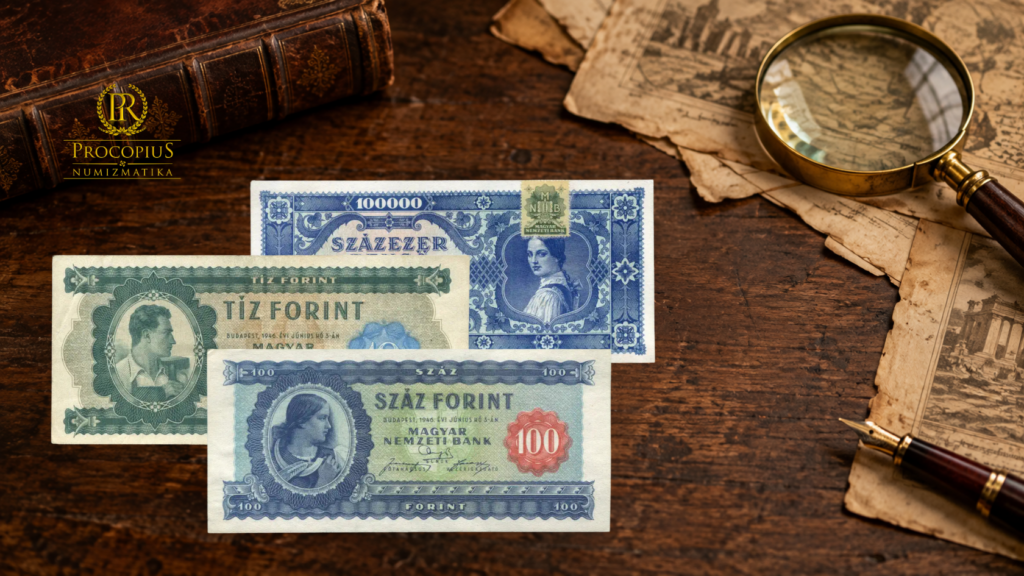
BANKNOTES
How do we start collecting banknotes?
Collecting paper money is perhaps one of the easiest areas of numismatics to get started in, yet it is surprisingly complex. For just a few thousand forints, you can buy historically interesting, attractive banknotes, whilst the price of rare and exceptional specimens can reach several hundred thousand or even several million forints.
However, a few questions soon arise for the novice collector.
What is worth collecting? What makes a banknote rare? How important is its condition? What do the terms UNC, UNC, EF or VF mean? Why does one banknote cost several times as much as another? And is it worth considering banknote collecting as an investment?
Let’s start at the beginning.
First, let’s choose an area rather than a banknote
One of the most common mistakes made by novice collectors is that they buy anything that is old, interesting or simply catches their eye.
This is perfectly natural at the beginning. Later on, however, it usually becomes clear that it is far more exciting to explore a clearly defined area in greater depth.
For Hungarian collectors, obvious choices might include, for example, the Austro-Hungarian Monarchy, the era of the crown, the pengő or the forint, Kossuth banknotes, emergency currency, sample banknotes, or a specific historical period.
Others are drawn not to a particular country, but to a specific theme: inflationary currencies, special serial numbers, design drafts, proofs or simply the world’s most spectacular banknotes.
As a beginner, you don’t necessarily have to hunt for rarities.
The first and perhaps most important aim is to we learn to recognise the banknote.
Just because something is old doesn’t necessarily mean it’s rare
This is one of the most fundamental rules of collecting paper money.
A hundred-year-old banknote may be common and of relatively low value if a large number of them have survived. A banknote that is considerably younger, on the other hand, may be a genuine rarity if only a few were ever printed or very few have survived.
This value is shaped by a combination of several factors:
rarity, demand, condition, variant, serial number, authenticity, historical significance and collectors’ interest in the subject area.
For this reason, the price listed in the catalogue is never, in itself, set in stone.
The true market is primarily reflected in the fact that what prices items of a similar quality have actually fetched at auctions in recent years.
Condition is particularly important when it comes to paper money
Paper is an extremely delicate material.
A crease, stain, tear, worn corner, moisture, gluing, cleaning or unprofessional restoration can significantly affect the value of a banknote.
Consequently, there may be a price difference – perhaps even several times over – between two banknotes that appear to be completely identical.
This is particularly true of the most common types.
A common banknote in average condition is often easy to come by. However, a truly flawless, genuine, uncirculated example of the same type is considerably harder to find.
The situation is different when it comes to rarities.
If only a few copies of a banknote are known to exist, even a VF specimen – or one in even poorer condition – can be extremely valuable.
With common banknotes, it is often the quality that determines their value. With genuine rarities, it is the banknote itself.
UNC, aUNC, EF, VF – what do they actually mean?
On the European and Hungarian markets, the condition of banknotes is traditionally indicated by letters.
UNC – Uncirculated
A banknote in absolutely pristine condition, with no signs of wear. Original paper, natural finish, sharp, unworn corners.
aUNC – About Uncirculated
In almost mint condition.
A In Procopius’s *Practical Numismatics*, the abbreviation ‘aUNC’ always refers to an uncirculated banknote. Minimal corner wear visible to the naked eye or slight signs of use may still be present, but there are no drive edge marks.
EF+ – Extremely Fine Plus
An exceptionally fine, original banknote, which does, however, show a slight crease or minor signs of wear from circulation. The paper may still be strong and crisp, and the overall appearance may be close to that of uncreased examples.
EF – Extremely Fine
A banknote that has seen light circulation, with one or a few noticeable creases, but is still in good, sturdy condition.
VF – Very Fine
A banknote that has been in circulation, with several creases and signs of wear, but is still intact and in good condition.
F – Fine
A copy that has seen heavy use, with numerous creases and signs of wear.
The levels can, of course, be more detailed than this, but for beginners, these are the most important basics.
Where do we draw the line between UNC and EF+?
This is an important issue from a professional point of view, as practices among European auction houses and dealers are not entirely consistent.
In Procopius Numismatics’ grading practice, the dividing line is clear:
The aUNC banknote must be uncreased.
Minimal corner wear visible to the naked eye may still be acceptable within the aUNC category.
However, if the banknote has any actual creases – even if it is just a single, slight crease – it is no longer considered to be in UNC condition. In such cases, an otherwise beautiful, genuine specimen made of strong paper can be graded no higher than EF+.
There is a simple reason for this:
Whether a banknote has been folded or not is not a matter of perception: it has either been folded or it hasn’t.
This practice may be more stringent than that of other international grading systems. Consequently, the designations ‘aUNC’ or ‘EF+’ appearing in the catalogues of two different auction houses do not necessarily indicate exactly the same condition.
Beginner collectors should therefore not just look to see whether the banknote is marked UNC, aUNC or EF.
Take a look at the banknote itself.
The significance of crinkly paper
Experienced banknote collectors often use the „strong, crisp paper” expression.
This does not simply mean that the banknote is stiff.
Original banknote paper has its own natural texture, surface and character. Frequent use, moisture, washing, pressing or other forms of handling may alter these characteristics.
An original VF banknote made of strong, natural paper may often be more sought-after by collectors than a specimen that is apparently more attractive but has been bleached, pressed or otherwise „enhanced”.
This is particularly important in the case of old Hungarian banknotes and those from the era of the Monarchy.
The embossed banknote will not be creased
The artificial restoration of banknotes is not a new phenomenon.
A creased banknote can be made noticeably smoother by wetting, pressing or ironing it. At first glance, it may even appear to be UNC or have an UNC-like appearance.
However, this does not make the shoot disappear.
Under suitable side lighting, the crease, the break in the paper fibres or changes to the surface are often still visible.
That is why, if possible, we should not just look at banknotes from the front.
Let’s move it in the light and examine it from the side as well.
This is one of the simplest, yet most useful, methods a beginner can learn.
European and American certification – two different approaches
On the Hungarian and European paper money markets, traditional UNC–aUNC–EF–VF we come across this system.
In the United States, by contrast, independent rating agencies and numerical scales have come to play a much greater role.
In the most widely recognised grading systems, banknotes are graded on a scale from 1 to 70. The uncirculated range is itself subdivided into several grades, which is why two banknotes that would both be described as ‘UNC’ in Europe may be assigned different grades under the American system.
Among other things, they take into account the centrality, the margins, signs of handling, the authenticity of the paper and the overall impression.
This is a more detailed system, but it is not necessarily better or worse – a different approach.
On the Hungarian market, the presence of rating agencies is currently significantly smaller than in the United States.
In the context of serious international sales, particularly of rare or exceptionally high-quality banknotes, independent grading may be an advantage, but for Hungarian and European collectors, the ability to assess a banknote with their own eyes remains essential.
We collect banknotes, not rating labels.
What has happened in the market in recent years?
The European paper money market has changed significantly in recent years.
Not all banknotes have increased in price by the same amount.
Perhaps one of the most important trends is that an ever-widening gap has emerged between average and outstanding material.
In the market for common banknotes in fair condition, price rises were often more moderate. In certain areas, supply remains substantial; consequently, age alone did not result in a dramatic increase in value.
However, a different trend can be observed in the case of rare, sought-after and high-quality banknotes.
More and more collectors are looking for fewer, but better pieces.
In some collections, quality, rarity, authenticity and provenance are increasingly taking precedence over the number of items.
What has actually gone up in price?
Based on experience in recent years, there has been particularly strong interest in:
- for genuine rarities;
- early banknotes in exceptional condition;
- rare specimens and proof prints;
- the variants that have survived in the few known copies;
- historically significant emissions;
- as well as specimens of exceptional quality from rare species.
In such cases, we may see a significant rise in prices over the course of a few years compared with the result of a previous auction.
However, it would be dangerous to draw the conclusion from this that „Old banknotes are a good investment”.
Not every old banknote is rare, and not every rare banknote is in high demand.
For a significant increase in value to occur, several factors generally need to come together at the same time:
rarity + quality + demand + historical or collectable significance.
Hungarian banknotes – where can we spot any interesting trends?
Collecting Hungarian banknotes is a particularly interesting field because the domestic market is relatively small, whilst at the same time there is international demand for certain Hungarian banknotes.
This is particularly true of the period of the Monarchy, early Hungarian issues, certain korona and pengő banknotes, rare specimens, proofs and special variants.
In recent years, significant price rises have been observed on several occasions in the market for truly rare Hungarian banknotes.
In the case of common types, however, the condition has come to play a much greater role.
We might come across another one just like an average VF model at any time.
It’s no longer certain that there is an original, beautiful UNC specimen.
This is why the price difference between UNC and VF grades can be surprisingly large for certain banknotes.
What should you buy as a beginner?
Mainly things that interest me.
Collecting remains enjoyable in the long term if we do not focus solely on price movements.
There are, however, a few rules that are worth following.
Better one good one than five mediocre ones
If our budget allows, it is generally worth choosing a higher-quality option within a particular type.
This does not, of course, mean that you have to buy an UNC copy of everything. In the case of a truly rare item, acquiring a fine VF copy can in itself be a significant achievement for a collector.
Let’s get to know our own collection area
If you’re collecting pengő, find out about the different variants, signatures, years of issue, serial numbers and rare pieces.
The more we know about a property, the less likely we are to buy it on the basis of nothing more than a flowery description or a high asking price.
Let’s take a look at the sales results!
We shouldn’t just look at how much someone is offering for a banknote.
The asking price is not the same as the market price.
Anyone can advertise a banknote for one million forints. The real market information is that how much someone paid for it.
A good point of reference, for example, could be the Vatera’s free-to-access archive price database, where numismatic items that have previously been sold – including Hungarian banknotes – can be traced.
The database can be particularly useful for gaining an understanding of price levels in the domestic market, but when making comparisons, one must always take into account the condition of the banknote in question.