

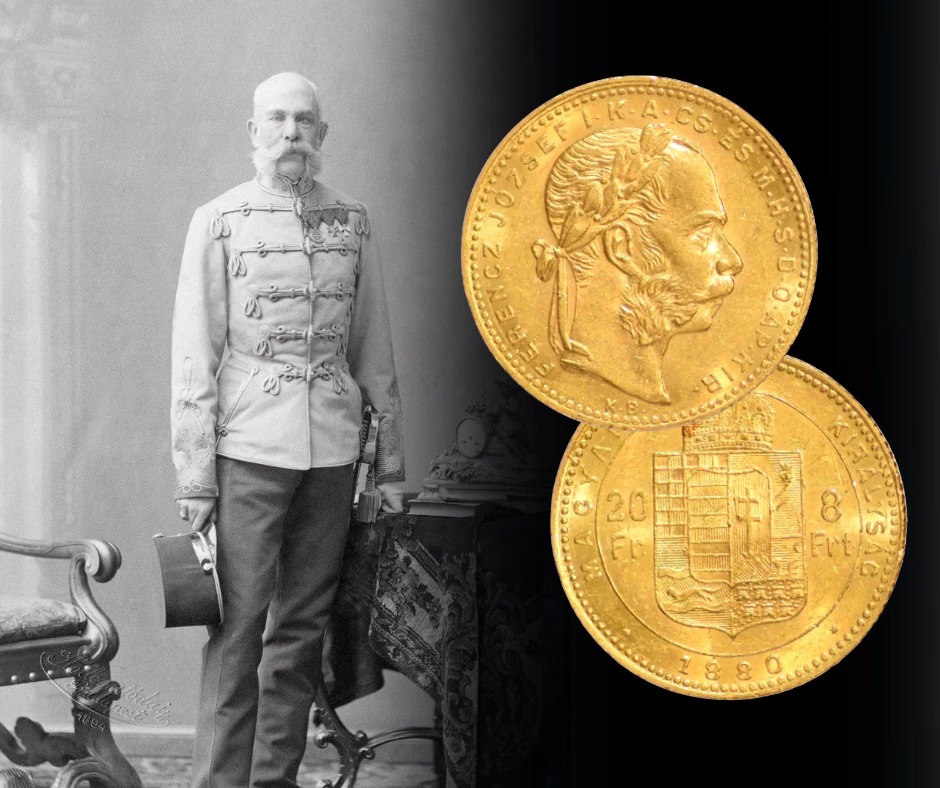
A „world money” in Hungarian robes, why was it born, what was it used for and why did it never become a people's money?
One of the most fascinating, yet often misunderstood, gold coins in 19th century Hungarian monetary history is the Hungarian 8 forint. It is called a forint in name and is Hungarian state money in appearance, but its function was clearly that of an international settlement gold. This duality gives it its uniqueness - and also explains why we see it much less often than we might at first think.
This blog post summarises what we know for sure about the 8 forint and helps to place this coin in the monetary policy thinking of the time.
On the threshold of a new era - why did we need 8 forints?
In the decades after the Reunification, one of Hungary's most important financial issues was how to bring the domestic forint-based monetary system into line with international gold circulation. In Europe, gold coins based on francs - especially the 20 franc - were already the benchmark.
The Hungarian response was not complete regime change, but accommodation.
The result was:
the 4 forint gold (10 francs) and
the 8 forint gold (20 francs).
The launch of the 8 forint coinage in 1870 was not a numismatic curiosity, but a conscious monetary policy decision: Hungary wanted a gold coin that would be a forint at home and instantly recognisable abroad.
20 francs - 8 forints: not a decoration, but a message
One of the most important features of the 8 forint is the dual denomination:
20 FR - 8 FRT
This inscription was not an aesthetic element, but functional information.
The money „said”:
within the Monarchy: 8 forints,
on the international money market: 20 francs.
This was a huge advantage:
did not need to be considered,
did not need to be recalculated,
no need to build trust.
The 8 forint was readable for Europe.
How did the 8 forint fit into the world of the Latin Monetary Union?
It is important to clarify: the Monarchy was not an official member of the Latin Monetary Union.
Nevertheless, he adopted its gold standard.
The 8 forint:
was the same weight and fineness as a 20 franc gold coin,
was effectively LMU-compatible „world money”.
This meant that the 8 forint:
in banks,
in foreign trade,
in international accounts
was as easy to handle as a French, Italian or Swiss 20 franc gold.
What was it actually used for?
It is important to say:
not for what you would normally use a loose change for.
The 8 forint:
not for daily purchases,
not to pay wages,
for non-petty transactions
served.
In contrast, typical uses are:
bank gold reserves,
foreign trade payments,
large financial transactions,
asset preservation.
It was a „desk drawer money”:
lived not in the pocket, but in the safe.
If it was legally circulating money, why was it not disseminated to the general public?
This question goes to the heart of the 8 forint.
- Too much value
An 8 forint gold coin was an extremely high denomination for the average income of the time. In everyday life:
silver coins,
banknotes,
banknotes
were spinning. - Gold is not „spending money”
The gold coins:
stored away,
have saved,
inherited or passed on -not spent. - Easy emigration
Because the 8 forint abroad is:
was immediately understandable,
carried a standard gold content,
in a natural way:
left the country, or
were melted down when the gold market dictated. - Not designed for this
But the most important reason is that it was not intended to be retail money.
The 8 forint was a monetary policy instrument, not a social currency.
The age of Franz Joseph and the role of the 8 forint
The Hungarian 8 forint gold coins are typical of the reign of Franz Joseph:
are traces of a transitional period when:
Hungary still used a forint-based system,
but is now open to the international monetary world based on gold,
and the most important medium of trust was gold.
The „afterlife” of the 8 forint”
The age of the 8 forint gold coin:
It lasted from 1870 until the end of the forint era,
after the 1892 crown reform, their role ceased,
a significant part of the stock has been merged or moved abroad.
This is why:
today there are few of them left,
are particularly rare in nice condition,
and historically tell much more than their face value implies.
The Hungarian 8 forint gold coin is not special because it is 8 forints,
but because it was 20 francs.
At a time when Hungary was still searching for its place on the financial map of Europe, this coin knew exactly which table it wanted to sit at.