


Power, crisis and minting at the end of the 14th century
In the second half of the 14th century, Hungary was still one of the most powerful and wealthy states in Central Europe. The reign of King Louis the Great brought stability, prosperity and foreign policy prestige, but his death (1382) brought an era to an end. The kingdom faced a series of challenges: the division of the nobility, the accession of a female heir to the throne and the political struggles of the late Angevin era.
In the absence of a son heir to the throne, the Hungarian orders accepted that Mary of Anjou, aged only 11, should inherit the throne. Although she was crowned king - rex - she exercised no real power. Her mother, Queen Elizabeth, and the Garai party ruled the country. However, a significant part of the nobility did not agree with female rule: they supported a male pretender, Charles Minor of Naples. The tension between the two political camps soon turned into a bloody conflict.
In 1385, Charles Minor was crowned king, and Mary's throne was shattered. Queen Elizabeth organised an assassination attempt against him, which was brutally repulsed by the overlords: Mary and Elizabeth were taken prisoner and the Queen Mother was murdered. Mary was held captive for months. The power vacuum was filled by Sigismund of Luxembourg, who was betrothed to Mary and later her husband. He was crowned king in 1387, and effective control passed into his hands. Mary remained formally co-regent until her death in 1395.
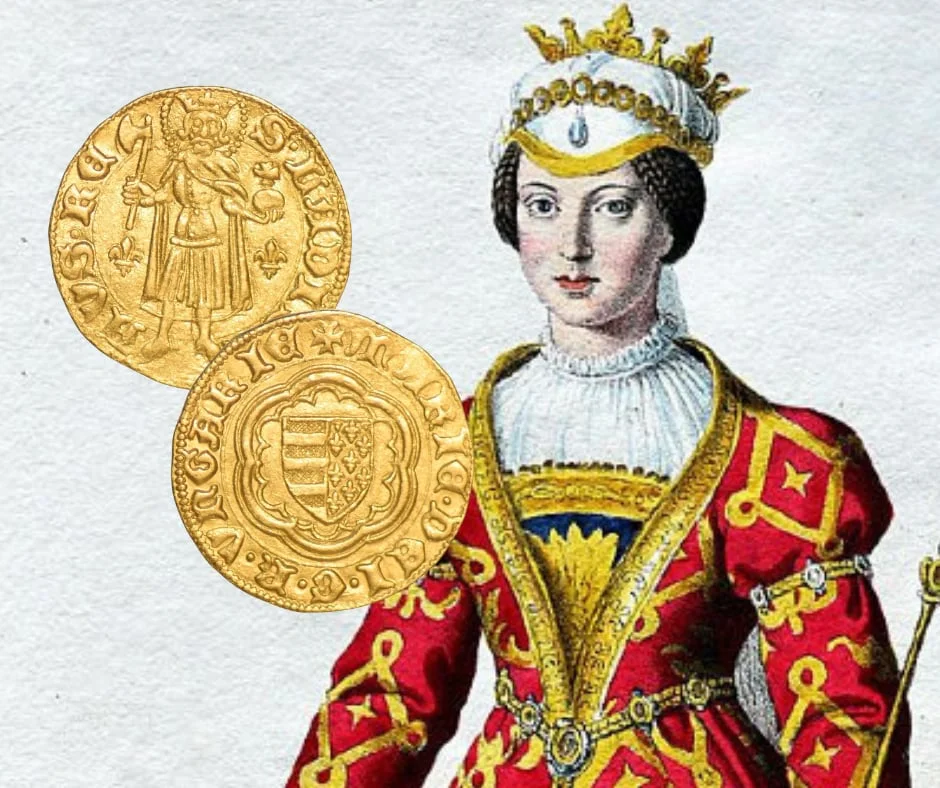
The coinage of the period is particularly fascinating because it is an accurate record of political turmoil. Coins in the Middle Ages were not just a means of payment: they were themselves the „calling cards” of the rulers' power. Mary's money reflects the duality that characterised her reign. There is both a desire to retain power and a sense of uncertainty, which is reflected in the short and fragmented minting series, the frequent mint changes and the rich variety of variants.
Its gold florins continue to be of high quality, following the iconography of the time of Louis the Great: the Anjou-Hungarian coat of arms on the obverse and Saint Lazarus on the reverse. These forints were not only sought-after coins in Hungary, but also in Europe. Their silver denarii and oboluses, although often of a more modest design, were easily recognisable by the crowned initials „M”, which emphasised the legitimacy of the female king. The late „crown denarius” type is already reminiscent of the transition to the Sigismund period: a larger crown, a more pronounced symbol system and more variations of the master's mark mark indicate the reorganisation.
After 1387, Sigismund gradually consolidated the minting of coins. He was responsible for the reorganisation of the chamber system, the stabilisation of supply and the standardisation of the mints. With the death of Mary, the late Angevin era came to an end and the Sigismund era began, which would define Hungarian coinage for a long time.
The short and tragic reign of Mary of Anjou is one of the most extraordinary chapters of the Hungarian Middle Ages. Although her actual political power was limited, her money survives and bears witness to the extraordinary circumstances in which she tried to maintain the appearance of royal power and statehood. The M-monogram with the crown, the Anjou coat of arms and the forints depicting Saint Lazio all convey the message that there was an effort to maintain order, continuity and royal authority in uncertain times.
This is why Mary's coinage is so special: it is an imprint of a period of crisis, where the coin is not just money, but a political message, a bearer of identity and a historical witness. The coins of this brief reign convey the voice of a kingdom in disarray, but still wanting to survive - even after seven centuries.