

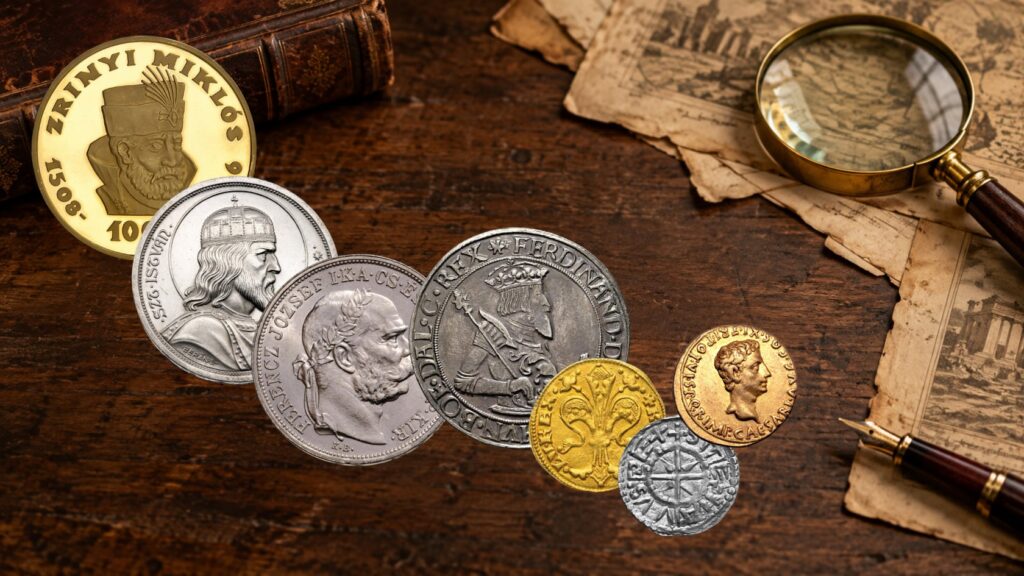
The scope of the collection
How do we get from modern coins to old coins?
Most coin collections do not begin as a consciously planned system. It usually starts simply with a coin that catches your eye. It might be beautiful, familiar, easy to obtain, or hold some personal significance. This leads to a second coin, then gradually a theme or an era emerges, and eventually the collection itself takes shape.
Many people start their collections with modern commemorative coins, circulation coins or coins from the recent past. This is perfectly natural. These items are easier to recognise, their details are simpler to verify, their prices are more transparent, and they can generally be purchased with less risk.
However, as their knowledge grows, many collectors’ interests gradually begin to look further back in time. First towards pengős and koronas, then towards krajcárs, tallérs, denars or even ancient coins. The more we know, the less strange a coin that is several hundred years old seems.
This is the natural progression of the collection.
The secure world of modern coins
Modern coins are a good way to get started in numismatics. The country, year and face value are clearly marked on them; they are easy to find in catalogues, and any variations are relatively well documented.
This is where the novice collector learns the basics:
- how to handle and store a coin properly;
- what ‘green light’, ‘wear’ or ‘cleaning’ mean;
- how the price is determined on the basis of rarity, condition and demand;
- what is the difference between face value, material value and collector’s value;
- how to use a catalogue and an auction database.
These experiences will later prove indispensable when collecting older coins.
Collecting modern coins is therefore by no means a lesser pursuit. It is a distinct and exciting field in which one can acquire just as much in-depth knowledge. Many experienced collectors stick to a single modern theme throughout their lives, building a high-quality, coherent collection within that theme.
When curiosity strikes
After a while, most collectors find themselves asking new questions. What came before the forint? What did a korona or a krajcár look like? Why did a monarch’s coat of arms change? Where were the mints of historic Hungary located? Why does one issue cost a few thousand forints, whilst another costs several hundred thousand?
At this point, the coin is no longer simply a space to be filled in the album, but becomes a historical source.
The collector’s focus gradually shifts from dates to coins, rulers, monetary systems and historical events. They find themselves leafing through catalogues and reading auction descriptions more and more often, and begin to notice the tiny details that were previously invisible to them.
A misprint, a heraldic discrepancy, an incorrect circular inscription or an unusual portrait can suddenly become more significant than the year itself.
Why is it harder to buy older coins?
The further back in time we go, the less frequently we come across coins that are exactly the same. In the case of hand-struck coins, the shape of the disc, the centrality of the strike and the legibility of the inscription may vary; indeed, even within the same type, several mint marks may occur.
It is therefore no longer sufficient to rely solely on the year of issue and the catalogue price when assessing old coins. Among other things, the following must be taken into account:
- authenticity;
- the exact model and variant;
- its rarity;
- the degree of retention;
- the quality of the casting;
- defects and damage to the sheets;
- any signs of cleaning or other intervention;
- the beautiful, original finish and patina;
- the origin of the item, that is, its provenance.
This complexity may initially cause some uncertainty. Later, however, it is precisely this that makes the world of old coins so fascinating.
Knowledge gives you courage
An experienced collector dares to buy old and rare coins not because they are less careful, but because they are able to spot more details.
They know what to look for on the surface. They are familiar with the characteristic striking features of the period in question. They can recognise when a piece is stylistically inconsistent, when the circular inscription is suspicious, or when the surface has been treated at a later date. They also know when it is best to seek expert advice.
Confidence, then, does not appear overnight. It is built up through many observations, much reading, many mistakes and many coins held in one’s hand.
You don’t have to take the plunge straight away
There is no need to jump straight from modern coins to the denars of the Árpád dynasty or the Transylvanian gold coins. It is far safer for the collector to work their way back gradually.
For example, anyone who collects modern Hungarian forints might, as a next step, explore the pengő coins of the Horthy era. From there, they can move on to the crowns of the Austro-Hungarian Monarchy, and then to Franz Joseph’s kreuzer-based currency system. Later on, they might move on to earlier Habsburg coinage, the coins of the Hungarian kings, or even the princely coinage of Transylvania.
In this way, each era provides a link to the next. Rulers, coats of arms, monetary systems and historical contexts do not all come at the collector all at once, but gradually come together to form a coherent picture.
Tips for moving forward
1. First, choose a period, not a rarity
Don’t make it your first aim to buy a rare and expensive coin straight away. Choose a more specific period that interests you, and first familiarise yourself with its history, monetary system and most common types.
2. Let’s watch lots of plays
It is not possible to learn about a particular type of coin from a single photograph. It is worth comparing dozens of examples in auction archives. Take note of the portrait, the lettering, the coat of arms, the mint mark and the areas showing natural wear.
3. Let’s start with the most common types
Common coins are generally cheaper, and as there are more examples known, they are easier to compare. They provide a more reliable way of learning about the characteristics of a particular period.
4. Don’t just look at the list price
The catalogue is a guide, not an automatic price list. Value is determined by a combination of condition, rarity, aesthetic appeal and current demand. Recent auction results often provide a better indication of the market than an older catalogue value.
5. A better situation usually leads to a better decision
As a beginner, it is easy to be tempted by a rarer coin that is, however, in poor condition or damaged. In the long run, a coin that is less rare but has a beautiful surface, is clearly legible and is authentic often brings much more pleasure.
6. Let’s learn to say no
You don’t have to buy every missing piece straight away. If you’re unsure about its authenticity, if the cleaning is unsatisfactory, if the price is too high or if the seller isn’t trustworthy, it’s better to wait. In numismatics, new opportunities almost always arise.
7. Ask for help when buying more expensive items
When it comes to older coins of significant value, an expert’s opinion is not an unnecessary expense, but rather an essential part of ensuring a secure purchase. This is particularly true of gold coins, rare talers, medieval coins and types known to be counterfeited.
8. Let’s manage the collection
Make a note of the item’s exact details: its weight, diameter, catalogue number, purchase price, provenance and date of purchase. This information may later prove to be an important part of the collection’s history and value.
It isn’t always necessary to go further back in time
The evolution of collecting does not necessarily mean that everyone will eventually end up buying ancient coins. Some collectors move on to increasingly earlier periods, others specialise in a single decade, whilst others research variations of a modern series at an ever-higher level.
Progress is not measured by the age or price of a coin, but by the fact that the collector is making increasingly informed choices.
A well-organised, modern collection can be of far greater professional value than a haphazard collection of old coins. It is not the antiquity of the collection alone that gives it its significance, but the knowledge, consistency and curiosity behind it.
The collection evolves alongside us
As our knowledge grows, so too does our perception of what we find beautiful or interesting. A coin that initially seems unremarkable may later prove more fascinating than a spectacular commemorative coin. A coin that is slightly worn but retains its original surface may speak to us more than a flawless modern issue.
This does not mean that our previous choices were wrong. Quite the contrary: without them, we would not have reached the next level.
The course of a collection is, in fact, the story of the collector’s own development. At first, we look for coins. Later, we seek out types, variants and rarities. Finally, we look for stories, connections and pieces that, for one reason or another, speak to us on a personal level.
The most important piece of advice, therefore, is simple: don’t rush. Look at lots of coins, read up on the subject, ask questions, and only move on when this new era no longer seems unfamiliar, but exciting.
Because a good collection isn’t created by filling an album quickly, but by learning to really see as we go along.