
History of the gold florins of János Hunyadi - One of the highlights of medieval Hungarian coinage
The world of medieval Hungarian gold coins occupies a special place in the numismatic history of Europe. For centuries, the stable gold currency created by the Angevins remained one of the continent's most reliable means of payment, and János Hunyadi joined this great tradition when, as governor, he minted his own gold florins. These coins were more than just currency: they were symbols of power, political messages and the imprint of an extremely turbulent era.
The legacy of the Hungarian gold forint
The history of the Hungarian gold forint began in 1325, when Charles I introduced the first stable Hungarian gold coin, modelled on the Florentine gold coin. The new currency quickly gained international fame for its high gold content and its constant weight. The rich gold mines of the Hungarian kingdom - especially the Körmöc and Nagybánya regions - provided the precious metal backdrop on which the country's financial stability was built.
During the 14th and 15th centuries, the Hungarian gold forint was not only an economic instrument, but also an object of representation. The imagery of the coins gradually became more Hungarian: the Florentine lily was replaced by royal coats of arms and Hungarian saints. A major turning point was the appearance on gold coins of the figure of Saint Lazarus during the reign of Louis I the Great. From then on, the knight-king remained one of the most important motifs on Hungarian gold coins for centuries.
The troubled era: Hungary in the mid-15th century
János Hunyadi's coinage can only be truly understood in the context of the political chaos of the period. The country was plunged into a long period of civil war after the death of King Albert. The forces vying for the throne, the Turkish threat and the struggle between the baronial factions caused almost constant uncertainty.
It was during this period that Hunyadi rose to become the most powerful man in the country, thanks to his exceptional military skills and political acumen. In 1446, he was elected governor of Hungary, and with him the right to mint money.
The role of the verde of Nagybánya
Almost all of Hunyadi's gold florins can be traced back to the blood of the Great Bánya. This is no coincidence: Nagybánya was one of the richest gold-producing centres in the country and was under Hunyadi's direct influence. The excellent raw material and the high quality of the workmanship at the mint enabled his gold coins to continue the tradition of the Hungarian gold forint in a worthy manner.
The technology of the era was, of course, still based entirely on manual coinage. Gold was melted, cast into bars and hammered into thin plates. From this, the discs were cut out and struck by hand with hammer blows between two hammerstones. Each gold forint was virtually unique.
Two main types of gold forint
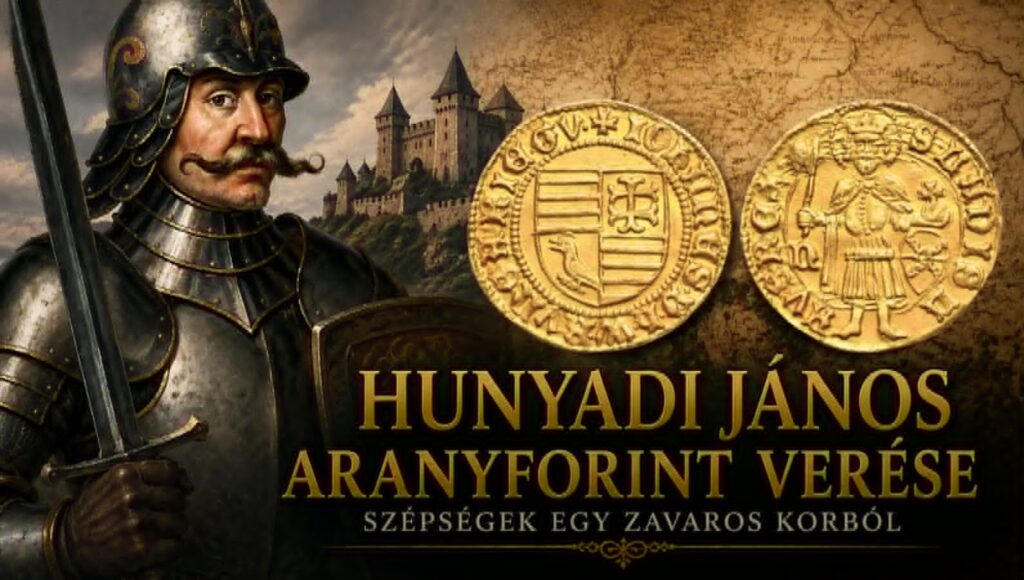
Research shows that Hunyadi basically minted two main types of gold forint. The reverse of both versions features a full-figure depiction of King Saint László, emphasising the continuity of the Hungarian royal tradition.
One type of coat of arms features the Hungarian cuts, the apostolic double cross and the Hunyadi scarf. In the other version, the Czech lion appears in place of the double cross, a reference to the complex dynastic and political relations of the period.
The Hunyadi pen is a particularly important motif. It was the most famous family crest, and later played a dominant role during the reign of King Matthias. The appearance of the raven on gold coins was a clear political message: Hunyadi wished to legitimise himself not only as a military leader, but also as a national power.
Saint László as a political message
The imagery of medieval coins was a conscious propaganda tool. The figure of Saint Lazarus was not simply a religious motif. The knight-king was the embodiment of the Christian ideal of rulership: a strong commander, a just king and a defender of Christianity.
This was particularly important for Hunyadi, who spent most of his life fighting the Turks. As the hero of the triumph of Nándorfehérvár, he became one of the most famous generals in Christian Europe. The use of the figure of Saint László can therefore be interpreted as a conscious self-identification.
Rarity and collector's value
Today, the original Hunyadi gold florins are among the most sought-after pieces of Hungarian medieval numismatics.
On the one hand, the mintage was much smaller than, for example, the Anjou gold florins. On the other hand, a significant part of the medieval gold coins was later melted down. The number of surviving examples is therefore extremely low.
Of particular interest to collectors are the mint marks, the subtle variations in the coat of arms designs and the different varieties of dies. A rare shield variant or a fine example in good condition also attracts considerable interest at international auctions.
The heritage of the Hunyadi gold coins
The gold florins of János Hunyadi are much more than mere coins. They bear witness to an era when Hungary was one of the strongest military powers in Europe, while constantly fighting for survival.
These tiny golden discs carry the strength of medieval Hungarian statehood, the idea of defending Christian Europe and the legacy of an extraordinary historical figure.