

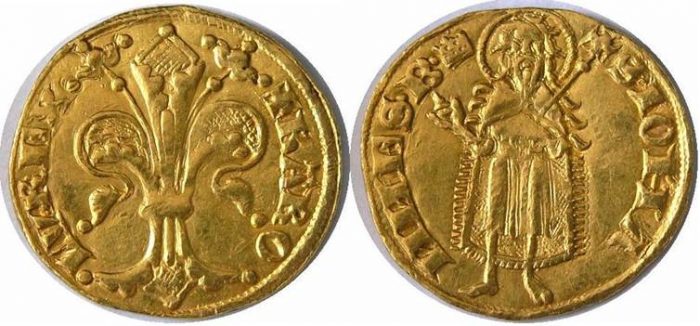
There have been few rulers in Hungary who have turned the economy around as much as Charles I (1308-1342). The king from the House of Anjou not only consolidated political power after the internal conflicts, but also put the kingdom's financial system on a completely new footing. It was during his reign that what would become a concept for centuries was born: the Hungarian gold forint, the „gold of Körmöc”.
⛏️ The land of gold
In the early 14th century, Hungary was Europe's largest producer of precious metals. The gold and silver mines of the High Tatras - especially Kremnica, Selmec, Nagybánya and Beszterce - produced 5-6 tonnes of gold a year, which was almost a third of the world's gold production at the time. Charles Robert took back royal control of the mines, introduced the urbura system (a tenth of the mine income was paid to the crown) and then directed the extracted precious metal into royal vaults.
⚖️ Financial reform and a stable currency
In the 13th century, the Hungarian silver denarius became so devalued that several coinage operations were carried out in a few years. Charles Robert realised that the country could only re-enter the European trade circuits if it introduced reliable, stable money. This was the purpose of the three-tiered monetary system: the silver denarius for everyday transactions, the garas for larger transactions, and the gold forint as international currency.
🪙 The first Hungarian gold forint
The first gold florins were minted around 1325 in Körmöcbánya. The weight of the coin was about 3.53-3.56 grams, its fineness was 23¾ carats (≈0.989) and its diameter was about 20 mm. 1 gold forint was counted in 100 denarii, which became the basis of calculation. The stable value of the money and its high gold content quickly spread throughout Europe, and the gold of the Roundel became a symbol of reliability.
👑 Iconography - Saint Lazarus, the royal ideal
Charles Robert deliberately chose the figure of King Saint Lazarus as the main motif for his coins. The obverse depicts St. Lazarus with crown, sceptre and orb; the reverse shows a cross with lily decoration in a beaded frame. The inscription MONETA AVREA REGIS HUNGARIE - Gold coin of the King of Hungary.
🧮 Denar-garas-gold forint: exchange rates and purchasing power
In medieval Hungary, 1 gold forint was counted in 100 denarii, but the actual market values slipped due to the decline in the silver content of the denarius. The garas, which followed the Czech pattern, became established under Charles Robert and was calculated from the reform of King Matthias at 1 garas = 4 denarii. In Central European practice in the 14th and 15th centuries, 1 forint was equivalent to 14-16 garas.
What could be bought for these sums? Compared to the value of a Prague garas, the price of a shoe or an axe was around 1 garas, a pig 5-29 garas, a cow 22-55 garas. A forint was therefore equivalent to the value of 1-3 cows. In 1336, the tax on gate money was 18 denarii a year, while a skilled craftsman could earn up to 16-28 forints a year. These examples illustrate the purchasing power and social importance of the gold forint.
💼 The role of the gold forint in trade
The Hungarian forint was accepted from Venice to Nuremberg, and was considered equivalent to the Italian fiorin or the Venetian ducat. The stable value of the gold coin boosted trade, made Hungary a reliable partner for foreign banking houses and laid the foundations for the financial policies of later powerful kings such as Sigismund of Luxembourg and King Matthias.
💎 The heritage of the Hungarian forint
After the death of Charles Robert, his son Louis I (the Great) continued to mint gold coins, the weight and fineness remaining unchanged. This stability was maintained for 500 years, and the standard of the 14th century gold standard was still reflected in the 18th century Maria Theresa ducats. The gold of Körmöc has become a benchmark in monetary history and a lasting symbol of Hungarian economic consciousness.
The Charles Robert gold forint is not just a historical currency, but a symbol of trust and value. More than 700 years on, it is a message that real value - be it gold, knowledge or credibility - does not inflate.